Violent incidents can develop faster than law enforcement can arrive, assess the scene, locate the threat, and reach the people in immediate danger. That reality does not diminish the importance of law enforcement. It means that, during the first critical moments, you may have to make decisions that affect your life, your family’s safety, or the lives of others around you.
The goal of concealed-carry training is not to turn someone into a vigilante or encourage them to move toward every dangerous situation. The goal is to prepare a responsible person to recognize a deadly threat, avoid unnecessary confrontation, protect innocent people when prudent, and act lawfully when there is no safer alternative.
A Concealed-Carry Permit Is Only the Beginning
Receiving permission to carry a concealed firearm does not automatically prepare someone to respond effectively during a violent emergency.
Responsible concealed carry requires training in:
- Safe firearm handling and secure carry
- Situational awareness and threat recognition
- Conflict avoidance and de-escalation
- Understanding state and local use-of-force laws
- Defensive decision-making under stress
- Identifying the actual threat
- Recognizing innocent bystanders and other armed citizens
- Knowing what is behind and beyond the threat
- Communicating with 911
- Responding safely when law enforcement arrives
- Providing emergency medical care when the scene is safe
Marksmanship matters, but judgment matters more. A person must know not only how to use a firearm, but also when not to draw it, when to move their family to safety, and when intervention may be necessary to prevent an imminent loss of life.
Your First Responsibility Is to Recognize What Is Happening
Preparation begins before an emergency.
When entering a restaurant, store, church, theater, workplace, or other public location, develop the habit of briefly identifying:
- The main entrance
- At least one alternate exit
- Areas that may provide protection
- The location of your family or companions
- Unusual behavior or rapid changes in the environment
This is not about living in fear. It is about remaining engaged with your surroundings instead of being completely distracted by a phone, conversation, or routine.
Situational awareness may allow you to leave before violence reaches you. Avoiding danger is a successful outcome.
Protecting Your Family Comes First
During an emergency, your first responsibility may be to move your spouse, children, or other family members away from the threat.
That requires a plan established before the emergency occurs.
Family members should understand simple commands such as:
- “Move.”
- “Follow me.”
- “Get behind cover.”
- “Call 911.”
- “Do not come back.”
If a safe escape route exists, leaving may be the most responsible decision. Carrying a firearm does not create an obligation to search for an attacker or clear a building.
Your firearm is an emergency defensive tool—not a reason to remain in danger unnecessarily.
When Intervention May Be Prudent
There may be circumstances in which a person faces an imminent threat of death or serious bodily injury and escape is not reasonably available. There may also be situations in which an innocent person, including a family member, is facing an immediate deadly threat.
In those circumstances, a properly trained and legally armed citizen may have to decide whether intervention is necessary to protect life.
That decision requires more than courage. It requires the ability to determine:
- Is the threat immediate and clearly identifiable?
- Do I understand who initiated the violence?
- Is escape or protection still reasonably available?
- Are innocent people between me and the threat?
- What is behind and beyond the threat?
- Could another armed person be an off-duty officer or lawful defender?
- Would drawing my firearm create a greater danger?
- Will I be able to stop acting immediately when the threat ends?
The purpose of training is to improve the quality of these decisions before someone faces them in real life.
Do Not Depend Solely on Law Enforcement to Keep You Safe
Law enforcement officers respond as quickly as circumstances allow, but they cannot be physically present everywhere at the moment violence begins.
During the first seconds or minutes of an emergency, the people already present may have to:
- Recognize the threat
- Move themselves and others to safety
- Lock or barricade a room
- Call 911
- Provide an accurate description
- Control severe bleeding
- Defend against an immediate threat when no safer option remains
This is not about replacing law enforcement. It is about remaining capable until law enforcement reaches you.
When officers arrive, they may not know who the attacker is. A concealed carrier must be prepared to follow commands immediately, keep their hands visible, avoid sudden movements, and understand that they may initially be treated as a possible threat.
Medical Training Is Part of Being Prepared
A defensive firearm does not treat injuries.
Anyone serious about personal protection should also receive bleeding-control and first-aid training. Once the threat has ended and the area is reasonably safe, trained civilians may be able to assist an injured family member or bystander before emergency medical personnel reach them.
Preparedness should include:
- Calling 911
- Applying direct pressure
- Using wound-packing materials when trained
- Correctly applying a commercial tourniquet when appropriate
- Keeping a trauma kit accessible
- Understanding when the scene is still too dangerous to enter
The objective is not merely to survive the threat. It is to preserve life afterward.
Training Must Include Judgment, Not Just Shooting
Quality concealed-carry training should present difficult and uncertain scenarios.
Students should practice thinking through situations involving:
- Crowded public spaces
- Family members who freeze or panic
- Blocked exits
- Low-light conditions
- Multiple armed people
- Innocent bystanders
- A threat that stops or retreats
- The arrival of law enforcement
- Situations in which drawing a firearm would make matters worse
The correct response will not always be to engage. Sometimes the best decision is to leave, take cover, protect your family, call 911, or become a good witness.
Training should build restraint as much as confidence.
Be Prepared to Act—But Only When It Is Prudent
Responsible concealed carry is not about looking for an opportunity to use a firearm. It is about being prepared to make the safest lawful decision available during a rapidly developing emergency.
That may mean escaping.
It may mean protecting your family behind a locked or barricaded door.
It may mean helping an injured person after the danger has passed.
In the most serious circumstances, it may mean taking lawful defensive action to stop an imminent threat to your life or the life of another innocent person.
The time to develop those skills is before the emergency—not during it.
Receive Responsible Concealed-Carry Training
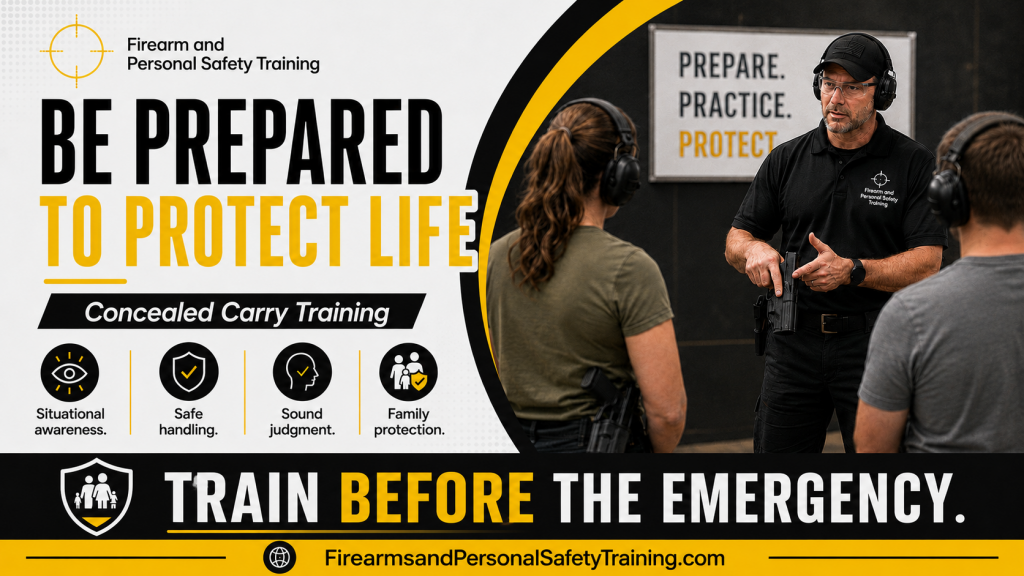
Firearm and Personal Safety Training provides instruction designed to develop more than shooting ability. Training focuses on responsible concealed carry, firearm safety, situational awareness, threat avoidance, defensive decision-making, and the responsibilities that come with carrying a firearm.
Prepare to recognize danger. Prepare to protect your family. Prepare to act when it is lawful, necessary, and prudent.
Learn more about concealed-carry and personal-safety training at:
FirearmsandPersonalSafetyTraining.com